

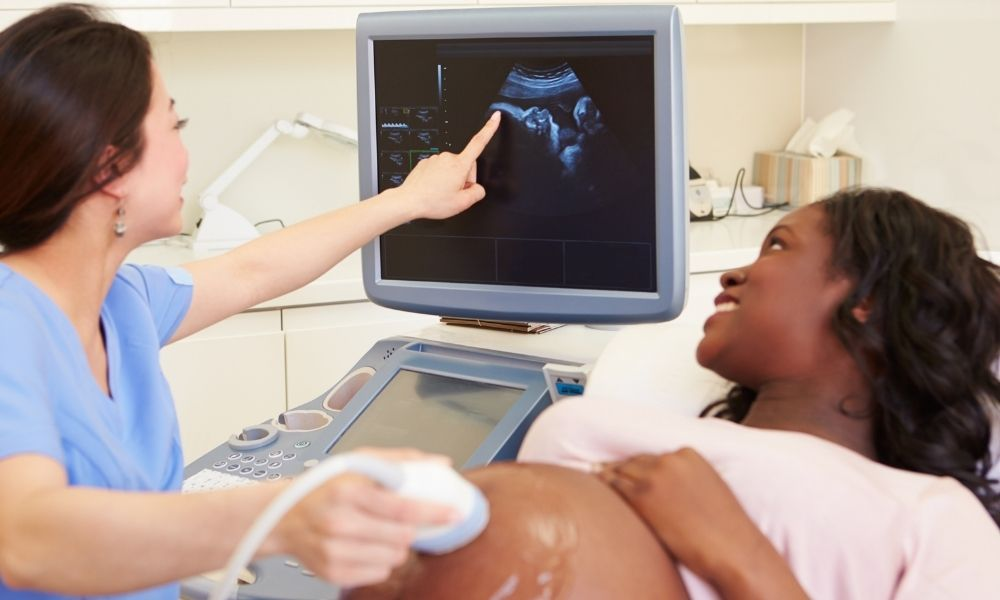
Ultrasound images are produced by sending pulses of sound and beam trajectories, or lines, through a transducer, which then reflect off a patient’s anatomy. The reflected images contain something called spatial resolution—the ability of the ultrasound array to distinguish the space between two individual points.
This space is measured in traditional units of distance; in the case of ultrasounds, smaller units of length, like millimeters, are more commonly utilized. Spatial resolution can be grouped into three primary subcategories: axial, lateral, and temporal.
Axial Resolution
Axial resolution measures distance along a line that’s parallel to the ultrasound’s beam. With axial resolution, objects exist at relatively the same depths, which means they’re generally unaffected by depth of imaging. Thanks to its diminished dependency on beam width, axial resolution is several times more efficient than lateral resolution when it comes to distinguishing objects.
The quality of axial resolution can be improved by using higher frequencies—and thus, shorter wavelengths. Frequency is enhanced through the use of high-frequency ultrasonic imaging (8 to 12 MHz). Since higher frequencies affect the beam’s ability to penetrate, high-frequency transducers are generally used in superficial imaging modalities (vascular, vein, breast, and small parts). These clinical applications require high axial resolution to provide good clinical data to the physician.
Lateral Resolution
Lateral resolution measures the distance between objects lying side by side, or perpendicular to the beam. When compared to axial resolution, lateral resolution is less reliable. It’s heavily affected by the depth of imaging and the width of the ultrasound’s beam. It is also known as azimuthal resolution.
Lateral resolution is improved through the use of high-frequency transducers and by enhancing the focal zone. As with axial resolution, the former diminishes the beam’s penetration capabilities.
Temporal Resolution
Temporal resolution refers to the ability to accurately pinpoint an object’s location at a specific moment in time. Unlike the other two subcategories of resolution, it’s measured in hertz and typically referred to in terms of frame rate.
Ultrasound transducers use temporal resolution to scan multiple successive frames and observe the movement of an object throughout time. Better frame rates enhance the ability to visualize rapidly moving objects, like valve leaflets and the fast-beating cardiac structure. Temporal resolution is enhanced by minimizing depth, line density, and by reducing the sector angle, thus increasing the frame rate.
The Interplay of Axial, Lateral, and Temporal Resolution
Axial, lateral, and temporal resolution are all relative to the type of transducer array being used and its construction. As stated, axial and lateral resolution decrease as the frequency of the transducer array goes down. However, the penetration of the ultrasound beam increases. The user cannot change the absolute axial, lateral, and temporal resolution of the transducer, but resolution can be enhanced by user controls on the system to an extent.
MXR Imaging is dedicated to providing world-class ultrasound service, products, repair, training, and support. Please contact us to discuss any need you may have for ultrasound machines, probes, parts, and more.